Piano playing made simple – Keith Jarret

The first time I heard the music of Keith Jarret I wasn’t sure if I was listening to classical music or jazz. It was in fact a completely improvised piano solo played live in concert. This first piece from the 1975 Koln concert in Germany was the first piece I ever heard from this artist and to this day it still remains one of my all time favorite piano pieces. The simplicity of the haunting melodies is deceptive and there are times when I would swear that this man sounds as if he has three arms. How can one man make such rich music on one piano? There are times when he is obviously hearing the music he wants to play and has run

out of fingers to play it so he starts singing the missing parts joining in with percussive knocking on the piano with his feet.

This artist has been a great inspiration for me and simply listening to him makes you feel that playing the piano can be a really simple task when it comes down to it.


How To Play All Of The Chords On The Piano
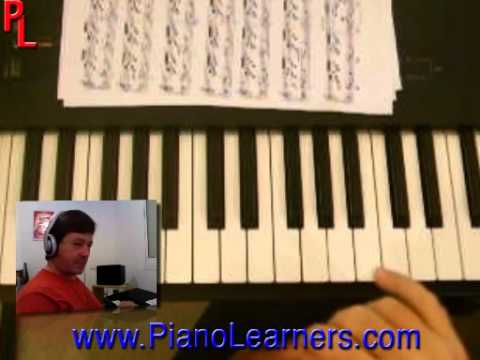
Here is another quick video I made… This one shows you ALL of the major and minor chords and should enable you to play virtually any song you like.

Am I Too Old To Learn The Piano?

Many people repeatedly inquire how old do you have to be before is becomes tricky to become skilled at the piano. This appears to be a regular question for persons over the age of fifteen. There seems to be a widespread misconception that once you get old then it is too late to learn the piano or keyboards.
Well the good

news is that this is false at all and in a number of cases it is in point of fact the contrary of the truth in that the older you are the more efficiently you will allow yourself to be taught.

When very young children are taught how to play the piano the advancement are generally really long-winded and frustrating for them. Regular practice is necessary and it can be really complicated for them remain interested.  The children who take up piano at an early age do not go forward enormously rapidly at first but over time they get better at leaning and soon start to perform and practice without thinking about it and the entire process becomes normal to them.

It is much easier for a teenager to learn piano than a small child. It is a good time to learn the piano whilst in your teens if you can manage to stay to a schedule of practice and attend all of the lessons as it can be simple to become distracted by schoolwork or other projects. See the Piano Lessons For Beginners page for more info.

In my opinion, the best time to learn to play the piano or the keyboards is as an adult. You will be able to practice and get good at the instrument a lot better as soon as you have your schooling finished and you have more of a daily schedule established in your life. You will be more motivated as you have chosen to learn the instrument yourself and you will be able to arrange your own practice sessions.. Learning like this is more than likely one of the most significant components to success. As an adult you will be able to see the reasoning behind your lesson plans and your practice sessions which will make you less prone to give up.

Check out this in depth video review of the top selling home study course for piano Rocket Piano

It is becoming ever more popular as of late for elder people to take up the piano. Older people in their 70′s and 80′s are every day taking up the piano and enjoying it immensely. The Delight of learning is what these people are looking for and not so much the objective of becoming competent, though many of them do achieve this even though they have had no prior musical know-how

So to answer the original question, am I too old to learn the piano? then the response has to be a distinct “NO”. You have just as much chance of progressing to a high level of playing if you start to learn the piano as an adult as if you begin as a small child.

Basic Piano Chords

Professional Piano ChordsLearning How to Create Basic Piano Chords

The basic piano chords are going to be very important to you in learning to play the piano. When you learn to understand chords you will be better able to read music and understand how to play the piano much easier.


Construction of Chords

Chords are made from musical intervals. A chord is composed of three parts. They are the root note, which gives you the name of the chord, a Major third or minor third and a Perfect fifth, Augmented fifth or a diminished fifth.
A Major chord has a root, Major third and Perfect fifth. A minor chord has a root, minor third and Perfect fifth. An Augmented chord has a root, Major third and Augmented fifth. A diminished chord has a root, minor third and diminished fifth.

For Slightly More Advanced Chords Click Here

Making a Chord
Now that you know the basic construction of each type of chord, you can being to create a chord. Major chords are the easiest to create. Simply choose any note as the root note. Now you choose the Major third, which is simply three notes from the root note. Now finish the chord with a Perfect fifth note which is five notes from the root note. An example would be a D chord. D is the root, F is the Major third and A is the Perfect fifth.
As you move into minor chords, diminished and augmented chords the notes you will use will include not only the white keys, but the black keys on your keyboard. It is simplest to start learning chords with the Major chords. For more information check out the Piano Basics page.

Playing Around with a Chord
Most of the time you will be playing a chord with all three notes together. Using our example, a D chord, you would play D, F and A together to form the chord. However, when you start looking at how chords are used in music you will see that they are not always played together. Sometimes you may just use two of the notes or you may play the notes separately.
You can play around with a chord to see all the different ways that you can use the notes within the chord together and separately to create a nice sound. Chords are usually used in the bass clef and played with the left hand, but they can also be use din the treble clef and played with the right hand. Try playing chords with both hands and experimenting to see what you can do with chords.

The Importance of Chords
Have you ever been listening to someone play the piano and they strike a note that doesn’t seem to sound right? Part of the importance of chords is helping you to see how the notes harmonize or go together. This is especially important for you if you are trying to learn to write your own music.

Professional Piano Chords For Everyday Pianists

You can use chords in many ways to create many wonderful songs on the piano. Through understanding the basic piano chords you can begin to see how music is written and become a song writer yourself.


How to Read Piano Sheet Music

The Basics of How to ReadPiano Coach Pro Piano Sheet Music

When you are learning to play piano you must learn how to read piano sheet music. Many people learn to read music in elementary school, however, if you are not in the band or choir, you can easily dismiss all that you learned. It can help to get familiar with at least the basics of sheet music before you get into your piano lessons.

The Staff
When you look at a piece of music there are different parts or elements that make up that sheet music. The first of those elements is the staff. This is the five line, fours space area where the actual notes sit. It is basically what the music is written on. It is the lines and spaces of the staff that tell you what note to play. At the beginning of the staff you will see a clef sign, either a treble or bass. There is a key signature and then a time signature. Each of these things help you to know how to play the music.

Clefs
The treble and bass clefs tell you the octave you are playing in. Generally in piano the treble clef is the right hand and the bass clef is the left hand. The clef sign will also tell you what notes each line and space of the staff represent.
In the treble clef staff the lines, from bottom to top, represent the notes E-G-B-D-F and the spaces are F-A-C-E. In the bass clef staff the lines, from bottom to top, represent the notes G-B-D-F-A and the spaces are A-C-E-G.


Check out Piano Coach Pro

Key Signature
The key signature tells what notes, if any, are flat or sharp. The marking for flat is an odd “b” and the marking for sharp is “#”. In the key signature the marking will be on the line or space of the note that is to be played flat or sharp.

Time Signature
The time signature tells you the number of notes in each measure. Measures are marked by a straight vertical line and they are used to break up the music. It looks like a fraction.

Notes
The last part of the sheet music are the actual notes. There are many different types of notes and each note has a specific length of time in which it is played. Here are some examples of notes you will see:
Whole note: Looks like an “o” Played for 4 beats.
Half note: Looks like a backwards “b”. Played for 2 beats.
Quarter note: Looks like the half notes but is filled in to make the “o” solid black. Played for one beat.
Where the notes are placed on the staff tell you what note to play. For example a whole note on the first line up from the bottom would be a G played for 4 beats. See the Piano Lessons For Beginners page for more info.
There are many more complexities that go into sheet music, but these basics should get you started with learning how to read sheet music proficiently. Once you know these basics you can then begin to learn the more complex aspects of reading sheet music.

Visit The Piano Coach Pro Web Site


Learn Piano By Ear

Piano For BeginnersLearning to Play the Piano by Ear

Some people have a natural musical inclination to play almost any instrument by listening to a particular song and transferring this sound to notes or chords. This is referred to as playing by ear. The average person cannot remember the exact scale of sound in a tune and this ability is unique.

If you feel that you possess such a talent, learning the basic scales could be very helpful in expanding your piano playing experience. A scale on the piano is comprised within a set of musical notes in any given octave. Octaves ascend and descend from the middle of the keyboard and define higher or lower pitches. Instead of laying your hands on the keys and fishing for the right combination, you will know for sure when first hearing the chord, where this chord lies on the piano.

Check Out the Piano For All Home Study Course

Notes will still need to be learned but this is not much more difficult than learning your basic ABCs, perhaps even easier because the notes on a piano only range from A-G. These keys are always white and the black keys represent the ½ steps. When a combination of the white and black keys is struck in a certain uniform arrangement, a scale is delivered.

With a natural skill for playing music by ear, learning the scales should not be difficult. Reading music may be more of a challenge but by understanding and learning the basic steps of scales and chords, your ability to read music as well as play by ear will make you sound like a pro in no time. When you are able to read music, you will find yourself automatically grouping notes together into scales and this is great since scales is what most music is based upon.

Playing by ear can be an advantage to the beginning piano player with other tools at their disposal. If you have already mastered another type of instrument through self-taught scales, learning the piano will be a piece of cake. Another trait of many that play by ear is the natural way that songwriting can be produced once the piano basics have been learned.
Listen to a song. Does the combination of notes stay in your mind as a blended effort or do you just recognize a good sound? If you are a master at blending and transferring without much effort, you can probably play by ear and should learn to play the piano to further your passion. Creating a certain rhythm comes next in the learning process. This may come easily or need practice to perfect. Simple keystroke exercises are readily available for any type of musical style that you like and to strengthen areas that may be weak. You may even come up with melodies of your own while practicing different, harmonic scales. See the Piano Lessons For Beginners page for more info.

Go To The Piano For All Web Site

To learn piano by ear and by reading music is by far the best as you are open to all posibilities and yet not restricted by having to play exactly what is written the page.

Piano Basics

Piano Basics – Tips on How to Play the Piano

Here is a video I made showing how to play the piano within 10 minutes of sitting at the keyboard.

Rocket Piano

Learning how to play the piano is something that many people aspire to do. It really is not too complex of an instrument to learn. Almost anyone can learn to play simple songs. Regardless of whether you want to just be able to play simple tunes or complex pieces, when you learn to play the piano you can really benefit from tips and advice to help make the process easier.

Tip#1: Give yourself time.
Learning to play piano requires time. Nobody learns to play overnight. Through practice and time spent going over lessons and what you have learned. You should never be too hard on yourself throughout the learning process.

Tip#2: Play everyday.
You may not feel like playing everyday, but if you take time off you will surely notice it. Your fingers have to get used to playing so much and if you take time off you will feel it in your fingers. Also it is easy to lose skill if you do not practice often. You will find after a few days off that you have to practice even harder to get back up to speed.

Learn The Piano Fast With Rocket Paino

Tip#3: Try learning pieces one hand at a time.
You should start learning a piece with your right hand first. When you can play through the piece well with the right hand then you can add in the left hand. This makes it much easier to learn and play the whole piece.

Tip#4: Train your ear.
A good piano player will have a good ear. This means that you can hear whether notes are correct. To train your ear you can try playing songs that you have heard. This will help you to figure out the right notes and be able to hear when you are playing the right notes. It is a great skill to have when you want to be a good piano player.

Tip #5: Do not forget playing should be fun.
Sometimes it can be too easy to turn playing the piano into work. For the best experience you should always play for fun. Make playing the piano enjoyable always. Do not let yourself think of it as work or something you have to do. Play when you feel like playing. When you do not feel like playing, then just sit down and play whatever you feel like playing. Do not be too rough on yourself. Some days you won’t want to play at all. You may sit down for a few minutes, play some scales and be done. That is fine. Just try your best to make it fun always. Play pieces that you like to help keep it exciting.

These tips are just some helpful advice that will help you to learn how to play the piano. When you take this advice you will be able to make learning the piano much easier. You will find that you struggle less and that you really enjoy the process of learning to play this amazing instrument.

Check out the Rocket Paino web site now

For more Piano Basics see the review of top home study courses at the Piano For Beginners Page

Blues Piano Chords

Learn blues PianoLearn To Play Blues Piano Chords

There is nothing like the entertaining sound that comes from a blues piano chords especially when played by a great Blues artist. Rhythm and sliding notes just seem to magically glide over the keys. You sit and listen in awe of the ease in which the pianist finds the perfect chords.
When you start your lessons, you will totally be amazed that the beginning of learning the blues consists of only three chords. Of course as you get more experienced and rhythmic with the scales, there will be more to learn like improvisation and neighboring chords that add motion and groove. Yeah, that’s what I want!

Piano For All – For Blues and Gospel

Learning the first three chords may not make you an expert right off but you will get the basic sound and yearn for more. The roots of blues and the soulful effort that went into every song ever written will pour from your veins to be the best that you can be.
Some of the techniques found in learning the blues to help you on your way to a richer sound include:

  • Different shuffle patterns
  • How to apply suspensions to the chords
  • Bass patterns for a Boogie-Woogie sound
  • Turnarounds and closings
  • Scales needed for improvisation.

There will also be exercises, tips and techniques provided to help you imitate the Blues greats with their blues bass and contrabass in addition to learning the harmonic laws of your selected style. Every style of music has its own order and list of reasons why they avalanche the way they do and the blues is no different. This creates the harmony that will hold the emotional tone of blues inside of you so as to better emit the singing of those keys to explode.

Blues Piano Chords

Learning a blues scale can also be one of the easiest scales that there is. Made up of only six notes, you may find yourself tiring of the sound but that’s ok because there are hundreds more to discover! There are bouncy blues, classic blues, walkin blues or just simple blues that can change a harmony by still delivering the noticeable style.
The right timing is something that is so important in playing the blues but that will come as you get into the rhythm and excitement of new scales. Don’t be surprised if you come up with a few chords of your own that sound great along with those that you have learned.

Check Out The Piano For All Web Site

Blues is an excellent way to begin learning how to play the piano especially when you are enhanced with a certain style and are ready to work toward your goal. It can be one of the most rewarding and entertaining things that you can discover and one where meaty, real sound just seems to get better with time.


How To Read Piano Notes

Rocket PianoLearning how to read piano notes and music can look like a foreign language to someone that has never set eyes on piano music before but once this language is explained, you will wonder why everything cannot be as simple.
The keyboard is split into two sections called treble and the other bass. The treble clef is usually played with the right hand, striking higher sounding notes and the bass clef with your left hand, delivering a low or bass sound.

The paper that the notes are written on is referred to as the staff. To the far left of each line, right before the notes begin, is where you will find these symbols. They indicate if you will be playing in a high note or a low note. More than likely, you will have two sets of staffs that separate the clef and the bass to easier read.

Learn how to read music and how to play by ear with Rocket Piano

The word clef is derived from the French word “clef” which means “key” in French. The treble clef is also referred to as the G-clef because of the resemblance to the letter. The bass clef is sometimes called the F-clef. You will learn to look for these symbols each time you open a page of music so you know when your hands are suppose to go. See the Teach Yourself Piano page for more information.
This may all sound confusing to you at the moment but think about the first time you picked up a cell phone or an I-Pod. You probably said, “What the heck do I do with this?” But before long, you were punching in numbers and texting like a pro. That’s the way it is with reading piano notes. You will wonder why you were so scared to learn.

Go To The Rocket Piano Web Site

The notes on the staff have a special line for each note but they go up in the order of the alphabet so it isn’t difficult to learn. For the bass, the opposite is true. The notes go down in the order of the alphabet. Sometimes, using a little saying helps in the learning process. For example, spaces on the treble clef and the notes filling those in forms the word: F A C E. This helps some in remembering where the exact location is for each note until you get the hang of it.
Once you have the piano notes down on the sheet music, you match them up to the keys on the piano and that’s when the fun starts. When you realize how easy it is to know that this note goes with this key, you are ready to start playing and chances are, you will be ready to go to the next step.

Rocket Piano

Learning the notes and putting them to the keyboard is simple with the right instruction and remembering them is even easier.


Teach Yourself Piano

Teach Yourself Piano

If you want to start playing the piano, you may be surprised that there are many advertisements and tutorials out there for you to learn how to teach yourself piano.  While learning the piano can be quite challenging and you will find that there are many things that you need to keep in mind when you are learning it, you will find that with enough time and dedication that it is completely possible to learn how to play piano independently.  Take a look at some tips that can help you along if you decide to learn how to play the piano on your own.

Click here for the Best online piano course

1. Go online
When you are thinking about tackling the piano on your own, remember that there are many different resources that can help you along.  Go online and find out what books and what programs come most highly recommended.  Read up on the various different options that other people have used, and make the most out of various different testimonials that you can find.  Take some time and find out what methods are going to work well for you, whether you want to try some learning software or whether you are interested in a book.

2. Learn to read music
When you are considering how to teach yourself piano, you’ll find that reading music is something that you need to learn how to do.  Ideally, you will find that you can start doing this quite easily with a book on the subject.  If you can learn to read music, you will find that you can spring forward a lot faster than you would if you were learning as you go.  Learning to sight read a piece of music will give you the boost that you need when it comes to learning a new piece of music much more quickly.

3. Practice, practice, practice
Whether you are learning with a traditional tutor, or you are learning on your own as go, you will find that getting practice time is essential.  There are many different ways that you can divide up your practice, but you will find that in the long run, you will want to do more practices regularly, instead of doing longer practices sporadically.  The more regularly you practice, the faster that playing the piano will get into your muscle memory and the better you will get when it comes to playing in general.  Remember that setting time aside to practice and just doing it will be the thing that moves you forward.

4. Play critically
One of the things that can really help you out when you are looking at learning to play the piano is the idea of considering what the composer meant when he wrote the piece.  Remember that the music in front of you was written with a great deal of thought and attention to detail, so as you play and as you work out how to play it best, take some time to think about why he or she might have chosen to write it in a certain way.  There are many different things that you can learn by really looking at the theory behind a certain piece of music, and the more time that you think about it, the more you will learn.

While it is still quite challenging, you will find that learning how to teach yourself piano is a lot less difficult than you think.  Take the plunge and make the commitment, and you will find that there are many different reasons why you want to think about taking on this feat!

Teach yourself piano online with Rocket Piano